Quality Standard Three
Teachers plan and deliver effective instruction and create an
environment that facilitates learning for their students.
For Standard Three, I believe I am proficient. I have established an effective learning environment for students and communicate clearly. I deliver effective instruction and evaluation methods that help me determine what and how students are learning. I incorporated relevant technology related to art and used technology effectively to keep organized, grade student work, communicate, provide unique artistic experiences, research, and practice literacy. I have designed and developed lessons that encourage empathy through collaboration and critical thinking through planning.
Element 3A: Teachers demonstrate knowledge about the ways in which learning takes place, including the levels of intellectual, physical, social, and emotional development of their students.
Learning happens in all stages of the art making process. For the projects at Webber, there were three parts: ideation & planning, studio time, final turn in & reflection. Each student had a sketchbook where they would participate in the research element of art making. This was often an activity where we practiced literacy, encouraging students to write. They would also use this sketchbook to envision what their art would look like with notes or drawings. These show me what students are thinking on an intellectual level. On dedicated studio days, students would attempt and execute their idea while I observed them, offering encourage or advice when asked. In this stage, they learn by doing, they learn from successes and mistakes, demonstrating emotional growth as they work through problems in their art while managing their feelings. Additionally, a choice-based classroom environment is designed for movement and social interaction. Students can move to different areas of the room for different stations and learn from each other. They would share ideas, discuss issues, hypothesize solutions, and offer assistance. During studio time, I encouraged them to talk to one another and see each other as co-creators. They had insightful conversations with each other and built positive relationships with their peers.


_edited.jpg)
Element 3C: Teachers thoughtfully integrate and utilize appropriate available technology in their instruction to maximize student learning.
At Johnson Elementary, my mentor teacher also taught a Digital Citizenship and Technology class in addition to art classes to be full time. We used the common sense education Digital Citizenship lessons, slideshows, videos, and worksheets to help our students understand important concepts about technology such as privacy, identity, balance, communication, and digital literacy. This allowed students to grasp highly complex technological concepts in easy to understand lessons. We would also assist their learning in other subject areas by drawing different types of lines and triangles to support the math curriculum with extra practice. Additionally, in the art classroom, we had a few iPads and laptops for student use. There was a digital art page with 20+ links to art games, which were simultaneously educational and fun. These games taught students how to draw with drawing challenges or step-by-step videos, color wheel mixing and exploration, virtual sculpture creating tools, and so much more. This allowed students who were not material-oriented and never discovered a material niche they enjoyed, or those who had sensory issues to art materials found the digital option much more appealing. There was lots of room for exploration, and students often went beyond the bounds of the websites linked for them and found even more opportunities to create digitally.


Element 3E: Teachers provide students with opportunities to work in teams and develop leadership.
At Johnson Elementary, I taught a lesson on collaborative journaling, using contemporary artist Mr. Doodle to explore the concept of doodles, and DJ Osmack to demonstrate what collaborative journaling looks like in a classroom setting. Students were very receptive to the artists and video. He has a silly personality, which helps me communicate to the kids that this is supposed to be fun, low stakes, and a positive way to engage with each other as art art community. Students worked together to draw and problem solve how to fill up empty space or how to work around existing drawings.


Element 3B: Teachers use formal and informal methods to assess student learning, provide feedback, and use results to inform planning and instruction.
My assessments were based on the Studio Habits of Mind (SHoM), as I feel it strongly reflects the activities of a studio artist and encourages different practices of the art making process. Both my summative and formative assessments were SHoM based, but looked different. The formative assessments were the planning and ideation slides and asked students to post a picture of any class activity and sketches with a SHoM check in that contained the wheel and asked students to circle the habit they felt they participated in, and a short sentence explaining why. For summative assignments, students would post a picture of their final projects and title it, fill out three reflection questions, and a self-assessment rubric based on the SHoM demonstrated in that project. This was useful during my grading to understand what students were learning and how they gauged their own process and efforts.


Element 3D: Teachers establish and communicate high expectations and use processes to support the development of critical-thinking and problem-solving skills.
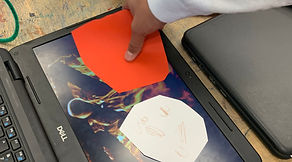
The first project I did during student teaching was a TASK party. This is a performative art project created by Oliver Herring, where there is a box full of tasks with artistic or collaborative challenges written on them. These could be something like, "have a tea party", "find a partner and create a handshake", "make a flower and give it to someone". The task is entirely up to interpretation. They're written anonymously, so you can't ask for clarification, but you still must complete it. There are materials set around the room to encourage art making and I noted the importance of community building with students, and asked them to consider working with or talking to someone they weren't friends with or didn't know. I communicated my high expectations by telling students that they will get out of it what they put into it, and I expected them all to try. I empathized that it might be uncomfortable at first, but that in the art room, taking risks and collaborating pays off! This activity encouraged students to think critically in their interpretation of the task, and how they could come up with tasks that were collaborative or artistic. Studnets had to problem solve in order to complete their task. "How can I make a tea party out of paper, tape, and pom-poms? Maybe I should invite people..." Below is Sammie's completed task of "make and wear a birthday hat" and Dylan working on his task of "cook your favorite food".

_edited.jpg)
_JPG.jpg)
Element 3F: Teachers model and promote effective communication.
I used Google Classroom as my primary mode of communication with my students. Here, I posted all of my assignments, materials, and grades within the same platform that students could easily access and use. I always placed a slide on the board with the objectives, instructions, or assignment along with verbally reiterating it. The grading feature within Google Classroom meant I could communicate directly with students which was especially useful for identifying and communicating about missing work and leaving personalized and unique comments praising their artwork. When introducing a new project, leaving the instructions, techniques, and/or objectives on the board allowed students to check in if they were ever confused or needed guidance. Of course, I also walked around the room monitoring their progress and checked for understanding.


