Quality Standard Four
Teachers demonstrate professionalism through ethical conduct, reflection, and leadership.
I feel I am proficient in this standard. I demonstrated my commitment to the teaching profession through my professional conduct with students, staff, administration, and parents. I wanted to get the most out of my student teaching experience, soaking up all advice and guidance along the way so that I could be as prepared and confident as possible for my future teaching position. Through creating this portfolio, I have had ample time to reflect on my conduct, and I believe my actions matched that of other teachers; attending meetings and special events, performing all extra duties as needed, and building strong connections with my students, the school, the staff, and this community.
Element 4A
Teachers demonstrate high standards for professional conduct.
My standards for professional conduct were very high, especially with the 6th grade classes that I completely took over. It was important to me that students saw me as their primary teacher, which meant showing up every day, designing and delivering their lessons, assisting and supporting them, and grading projects/providing feedback. I worked collaboratively with my mentor teacher to create a rubric for these classes that was equitable and incorporated the Studio Habits of Mind(SHoM) and Colorado Visual Arts Standards. I shared this rubric with students and explained each category, highlighting what you needed to do in order to earn a 4. I talked with students about their grades to ensure that their grade reflected what I was observing in class, and their level of effort.
Element 4B
Teachers link professional growth to their professional goals.
I had an opportunity to attend a Professional Development day with Amy Felder, a Culturally Responsive Teacher Training. This was a full day that explored the ideas behind why we need Culturally Responsive School Education and Curriculum. We talked about the long list of potential benefits including reduced fear and increased understanding from parents, applications for Social and Emotional Learning and empathy building, providing clarity and context, building trust and gaining support from administration, among many others. We read The Transformation of Silence into Language and Action by Audre Lorde and annotated it using the Critical Close Reading Tool. This consisted of five different lenses: Reading for Craft and Structure, Reading for Representation and Perspective, Read Around the Text, Readers' Experience, and Reading for Warrant and Reasoning. Each area uniquely investigated how we can critically think about a piece of literature for its word choice, author background, intended audience, emotional effect, and persuasiveness. Amy and I talked about how we could implement this into an art classroom using visual literacy; being able to analyze and break down the parts of an artwork for expression, meaning, subject, materials, artist background, intended audience, emotional effect, and process. We can help students understand how to interpret an artwork the same way they'd interpret literature.


Element 4C
Teachers are able to respond to a complex, dynamic environment.
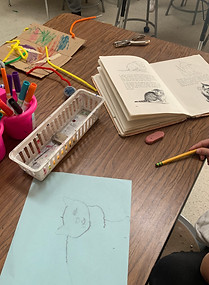
Running a choice-based or TAB (Teaching for Artistic Behavior) classroom is not easy. There is a lot of movement, commotion, excitement, and materials management that goes into maintaining a studio-heavy class. Every day is different, the classroom and the students are always changing. Student's interests change as they want to explore new materials or ideas. Their seats change if they are working together with someone or a group. There may be spilled paint, there could be a hot-glue gun burn, there might be a scuffle over a finite material. Reminding myself to stay regulated and consistent despite whatever may transpire in the class helps me be a source of strength and stability for students. Despite the unpredictability and challenges that come with a TAB class, I was able to engage with students in a positive and calm way. They came to me with questions, concerns, and to ask for help. Even if the class changed every day, I did my best to remain more or less the same - an optimistic, happy-go-lucky, enthusiastic art teacher.


Element 4D
Teachers demonstrate leadership in the school, the community, and the teaching profession.
At Webber Middle School, I participated in Specials Department Meetings and All Staff Meetings just like all other full-time teaching staff. I absorbed the material and participated honestly and authentically to the highest extent possible in relation to my temporary position as a student teacher at the school. I wanted my colleagues to see my effort went beyond being a student teacher, but rather an active member of the staff who participated as such. I engaged in discussion amongst the other staff when prompted, such as brainstorming about things like the increase in minor and major incidents at the school, how we could connect with students who feel disconnected from their peers and adults at the school, and appreciations we have for other teaching and classified staff. I implemented what I learned from these meetings and applied them to my classroom. Below is the document full of various meeting notes during my time at Webber highlighting what we discussed and any action I took.